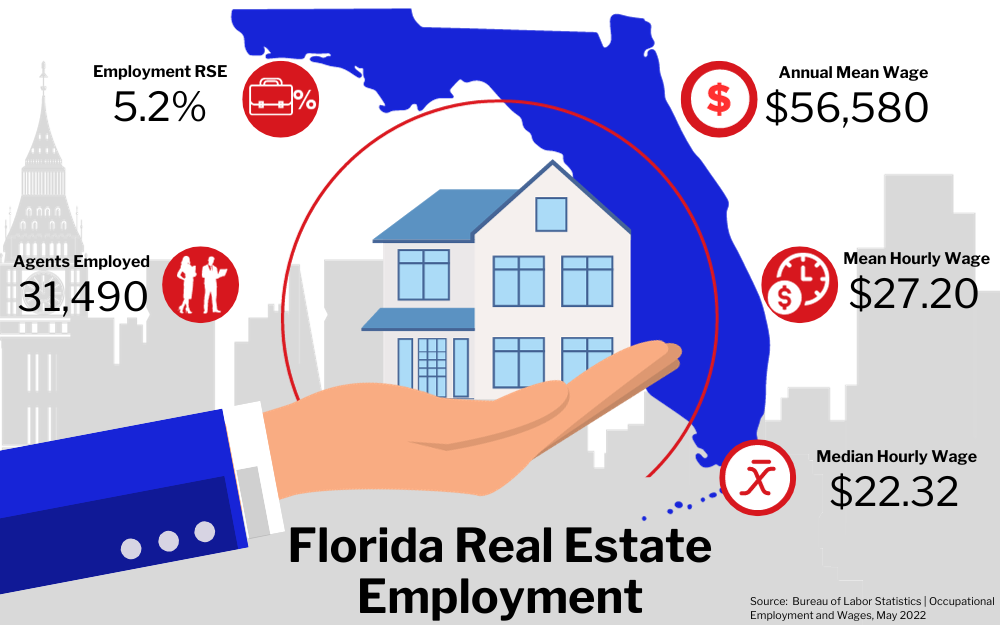
As more and more people move to Florida, and more and more businesses set up shop there, acquiring a real estate agent license from the Florida Realty Commission in the Sunshine State can be quite a lucrative proposition.
Obtaining a Real Estate License in the State
Getting licensed as a real estate agent in Florida is a pretty straightforward process. Like many professions, the first step will be meeting education requirements and demonstrating proficiency in the relevant information by passing an exam required by the Florida Realty Commission.
You will also need to meet the various requirements set forth by the Department of Business and Professional Regulation,1 which oversees professional licensing of all manner in the state, and the Florida Real Estate Commission (FREC).
All in all, the process is pretty straightforward, provided all requirements are met in a timely fashion, you can become licensed rather quickly.
Age and Basic Education Requirements
To become a Florida real estate agent you must:
- Be at least 18 years old
- Have a US social security number
- Have a high school diploma or the equivalent
Pre-Licensing Education
Aspiring real estate agents in Florida must complete a 63-hour pre-licensing education course. Exceptions include applicants who have a 4-year degree in real estate or are licensed attorneys in good standing with the state bar association.
The licensing exam must be taken within 2 years of completing the course, and applicants cannot sit for it if they present a certificate from an expired course. It is not necessary, however, to complete the course before applying for approval to take the test from the Florida Realty Commission.
The FREC has a designated syllabus all approved providers must follow and consists of the following sections:2
- Course Overview: The Real Estate Business
- Real Estate License Law and the Qualifications for Licensure
- Real Estate License Law And Commission Rules
- Authorized Relationships, Duties, And Disclosure
- Real Estate Brokerage Activities And Procedures
- Violations Of License Law, Penalties And Procedures
- Federal And State Laws Pertaining To Real Estate
- Property Rights: Estates And Tenancies; Condominiums, Cooperatives, Community Development Districts, Homeowner Associations, And Time-Sharing
- Title, Deeds And Ownership Restrictions
- Legal Descriptions
- Real Estate Contracts
- Residential Mortgages
- Types Of Mortgages And Sources Of Financing
- Real Estate-Related Computations And Closing Of Transactions
- The Real Estate Markets And Analysis
- Real Estate Appraisal
- Real Estate Investments And Business Opportunity Brokerage
- Taxes Affecting Real Estate
- Planning, And Zoning
Stipulated Training Time for Licensing
Many applicants take self-paced online courses, meaning people can move through the material as quickly or as slowly as they prefer.
Many in-person schools in Florida offer full and part-time options. The full-time option allows participants to finish the whole course in as little as a week.
The part-time option usually takes about a month, with classes meeting twice a week for several hours at a time.
Someone with other professional and personal commitments might require more time; some people may prefer to take more time to better absorb the information.
So long as the course is completed within 2 years of sitting for the test, it really comes down to what works best for the individual person.
Fee Schedule for Pre-Licensing Real Estate Education
The cost of pre-licensing education varies, with in-person classes typically costing more than the basic online courses. Online schools typically offer packages with different features.
For example, the most basic package will be just the course itself, while a more comprehensive package will have ‘extras’ like examination prep materials, flashcards, the ability to take the end-of-course exam more than once without an additional fee, an extended enrollment period allowing more time to finish the course, additional material covering things like real estate law, real estate math, etc.
Expect to pay around $200 to $300 for the most basic online course package. The most comprehensive package with all the ‘extras’ is typically anywhere from $500 to $600.
Many schools offer frequent sales on the courses, so you may be able to get them at a significant discount.
In-person classes are generally $400 to $500 dollars. These programs also appear to run special offers.
Real Estate Background Verification Conditions
The Department of Business and Professional Regulation requires a criminal background check before issuing licenses of various kinds, including real estate agents. A service called LiveScan provides electronic fingerprints.3
In Florida, there are over 114 providers,4 authorized to perform this service, most of them being UPS stores. Some require appointments and some allow walk-ins.
Be sure the provider is approved by the Florida Department of Law Enforcement. Bring the confirmation number from the appointment booking to the fingerprinting location.
Provide the correct ORI (Originating Agency Identification) number on your application, which indicates the profession in which you are seeking licensure.
The ORI for real estate agents and brokers is FL920010Z. This ensures the results are sent to the proper department.
Arrange for fingerprinting at least 5 days before submitting the license application so the results will be immediately available for review along with the application.
Bring two forms of ID, one of which must have a photo and signature.
The FDLE keeps prints on file for 180 days.
Having a criminal history doesn’t automatically disqualify someone from becoming a real estate agent in Florida. It depends on the nature of the crime.
First-degree offenses are likely to disqualify an applicant, such as a moral turpitude felony, a crime against an elder or minor, or sexual crimes. Some lesser felonies are subject to a disqualifying period of anywhere from 5 to 10 years.
If there is any sort of criminal history that may call the application into question, the Board of the DBPR will conduct a review and make a recommendation to the FREC. They may contact the applicant directly for more information.
Good moral character is paramount and the Board will look for evidence of that. This means that a person whose crime occurred decades ago, and they have not had any incidents since may have a better chance at approval than someone whose crime only occurred a couple of years ago.
References
1Department of Business and Professional Regulation – State of Florida. (2023). Department of Business and Professional Regulation. Department of Business and Professional Regulation Homepage. Retrieved October 26, 2023, from <http://www.myfloridalicense.com/DBPR/>
2Florida Real Estate Commission. (2023, January 1). Florida Real Estate Commission SALES ASSOCIATE COURSE SYLLABUS (FREC COURSE I). myfloridalicense. Retrieved October 26, 2023, from <http://www.myfloridalicense.com/dbpr/re/documents/FREC1SyllabusCleanFinal01012023.pdf>
3Department of Business and Professional Regulation – State of Florida. (2023, January). FREQUENTLY ASKED QUESTIONS ELECTRONIC FINGERPRINTING. myfloridalicense. Retrieved October 26, 2023, from <http://www.myfloridalicense.com/dbpr/servop/testing/documents/finger_faq.pdf>
4Certifix Inc. (2023). Fingerprinting Locations in Florida. Certifix Live Scan. Retrieved October 26, 2023, from <https://www.certifixlivescan.com/category/fingerprinting-service-locations/florida/>